Copilot Studio credits are becoming an architecture decision
It is tempting to leave Copilot Credits to whoever handles licensing. I think that is a mistake now. How an agent grounds answers, reasons, calls tools and runs flows directly drives what it costs. So credits belong in the design conversation.
The numbers
Copilot Credits measure usage across Copilot Studio. The cost is not per conversation: each capability has its own rate, and one reply can use several. Microsoft currently documents:
- classic answer — 1 credit;
- generative answer — 2 credits;
- agent action — 5 credits;
- tenant graph grounding — 10 credits;
- agent flow actions — 13 credits per 100 actions.
AI tools and reasoning models can add more, based on tokens and model type.
One reply, several meters
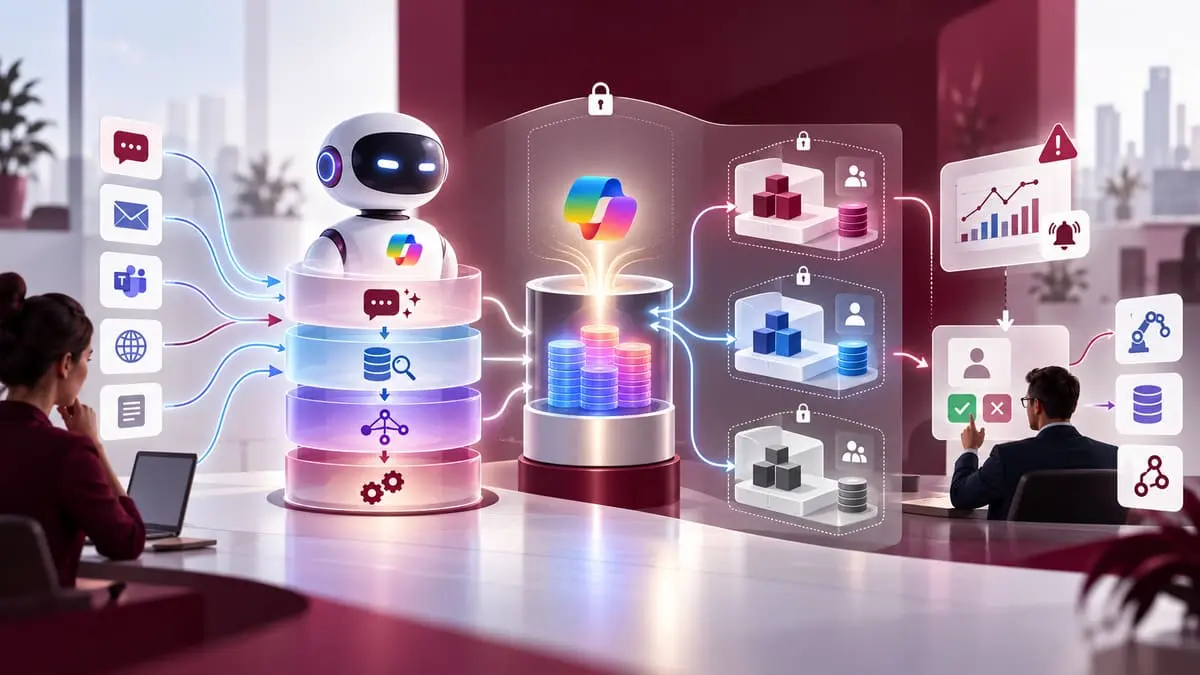
Picture a user asking a simple question. Behind the scenes the agent grounds against the tenant graph, reasons, calls a tool and triggers a flow. The user sees one answer. The meter sees four kinds of work.
That is why the visible conversation is a poor guide to cost. Tenant graph grounding might give better answers, but it changes consumption. An agent flow might make the process more reliable, but its actions need to be in the estimate.
Environments matter too
Credits are pooled at tenant level but allocated and monitored per environment. Unless administrators set allocation and overage behaviour carefully, a development environment can draw from shared capacity.
Johannes Enström described exactly this: a development environment hit enforcement while someone was testing an unpublished agent, because it was drawing from the tenant pool. His suggested controls were to turn off tenant-pool drawdown, use pay-as-you-go where it fits, and set per-agent limits. That is a practitioner's experience, not a Microsoft commitment, but it is an easy trap to fall into.
Common misunderstandings
- Copilot Studio agent flows are not the same as ordinary Power Automate cloud flows.
- Actual consumption depends on design, the capabilities invoked and the user's licence.
- Design estimates are guesses until you compare them with Monitor and the Power Platform admin centre.
- Pay-as-you-go does not remove the need for owners, budgets, alerts and limits.
I treat credits as feedback on the architecture. If nobody can explain why an agent costs what it does, it is probably hard to govern too. Mapping its steps usually shows both wasted consumption and unclear ownership.
Build a consumption map
Pick one live agent and write down its expected volume, grounding sources, tools, flows, models and environment. Compare that with its Monitor data and the Copilot Studio capacity view. Then set a monthly limit for the agent, decide the environment's overage behaviour, and move anything repeatable into deterministic automation.
Sources
References used for this article. Links open in a new tab.