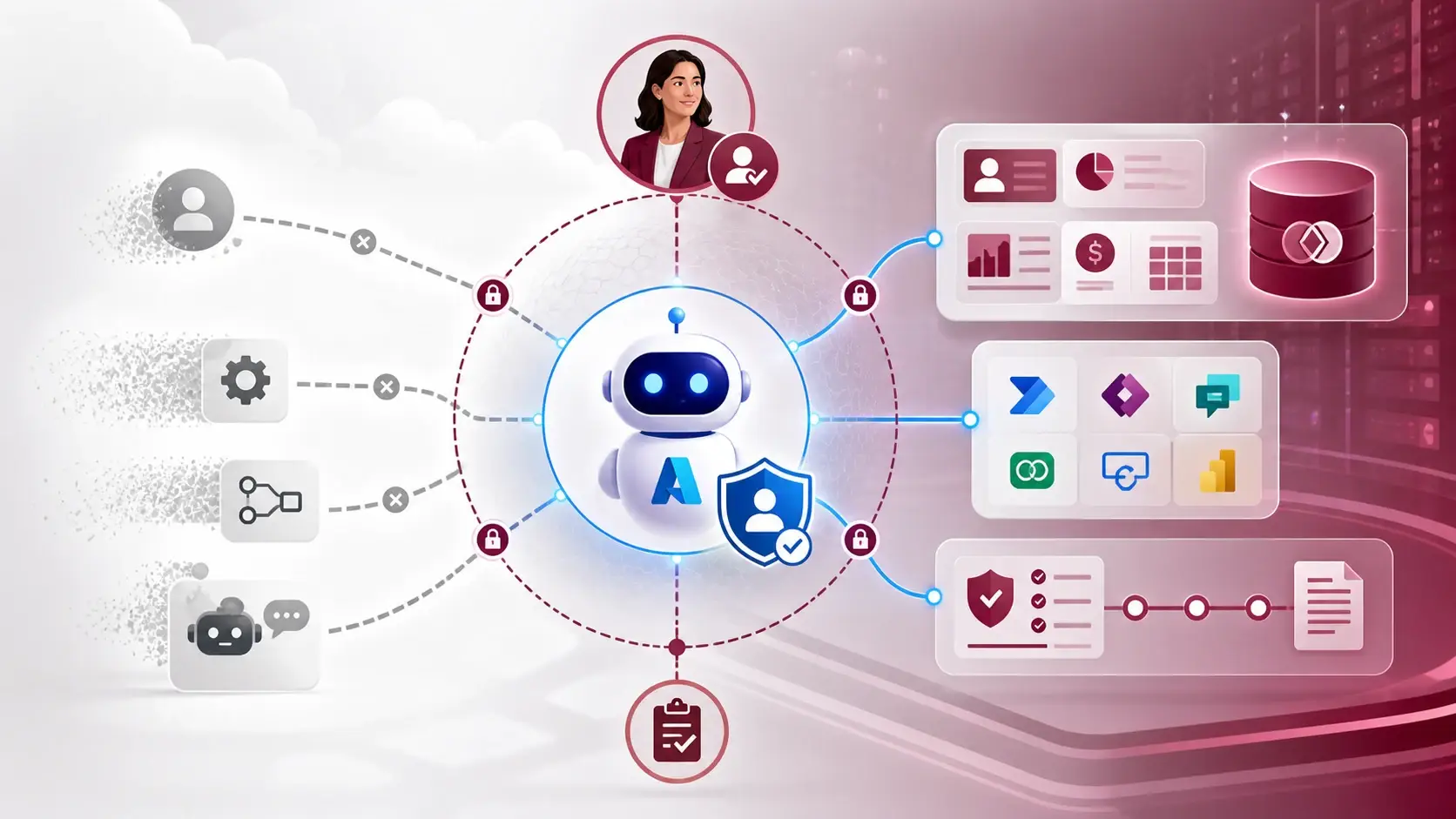
Power Platform apps need a governed path to AI, not just a Copilot button
When people ask me whether their Power Apps are "ready for Copilot", I usually answer with another question: is the app itself in good shape? An agent working inside an application relies on its data model, permissions and rules. A weak app underneath gives a weak AI experience on top.
Where Copilot now lives in apps
- Microsoft 365 Copilot is generally available in model-driven apps; canvas app support is in public preview.
- Power Apps app skills for data entry, exploration, visualisation and summarisation are generally available.
- App-based form and grid experiences in Copilot Chat were scheduled for general availability in July 2026.
- An agent feed gives users a place to see, review and guide agent activity inside model-driven apps.
On the data side, Microsoft describes Dataverse business skills — still public preview — as a way to bring schema, relationships and business logic into agent experiences. Treat them as evolving, not as a finished governance model.
What a weak app looks like to an agent
An agent cannot ask the person who built the app what they meant. It sees what is there. These are the problems I find most often:
- tables and columns with vague or legacy names;
- status values nobody governs, so "Closed" means three different things;
- security roles that do not match how the process really works;
- important decisions that live only in someone's head.
A polished conversation cannot make up for any of these.
What a good app gives an agent
The opposite is also true. Dataverse relationships explain how records connect. Security roles set what a user or agent can see. Business rules provide constraints. A review step keeps a person responsible for high-impact decisions while low-risk preparation happens automatically.
The aim is not autonomy everywhere. It is a clear split between preparing, recommending, approving and executing.
Fabian Hutzli's work on Power Platform as a delivery platform makes a related point: reliable platforms come from repeatable environments, traceable changes, reusable components and quality gates. Adding AI does not remove any of that. Prompts, app skills, flows and configuration are changes too, and they need an owner, a review and a way to switch them off.
Three scenarios to run
Choose a process such as case triage or an internal request. List the source tables, required fields, roles, the actions an agent may prepare, and the ones that need approval. Then try the current app with:
- a normal, complete request;
- an incomplete request;
- a request outside the user's permissions.
A useful answer is not proof the agent can safely create or approve a record, so watch the hand-off to a person closely. Whatever goes wrong becomes a short backlog for data quality, security, app design and AI evaluation. Also check release states for each feature in your region and tenant; preview, available and planned are not the same thing.
Power Platform maturity used to mean "can we build an app quickly?" Now it also means "can this app give people and agents dependable context without hiding the decisions that matter?" I would much rather start with one small, well-owned process than a broad Copilot experiment over data nobody fully understands.
Sources
References used for this article. Links open in a new tab.
- PuntoBello Blog — Building a Delivery Platform for the Microsoft Power Platform: Lessons from My Master's Thesis
- Microsoft — Making apps smarter with Copilot and app skills in Power Apps
- Microsoft — Dataverse Is Your Agent Data Platform: Here’s What’s New
- Microsoft Learn — Microsoft Power Platform 2026 release wave 1 plan overview