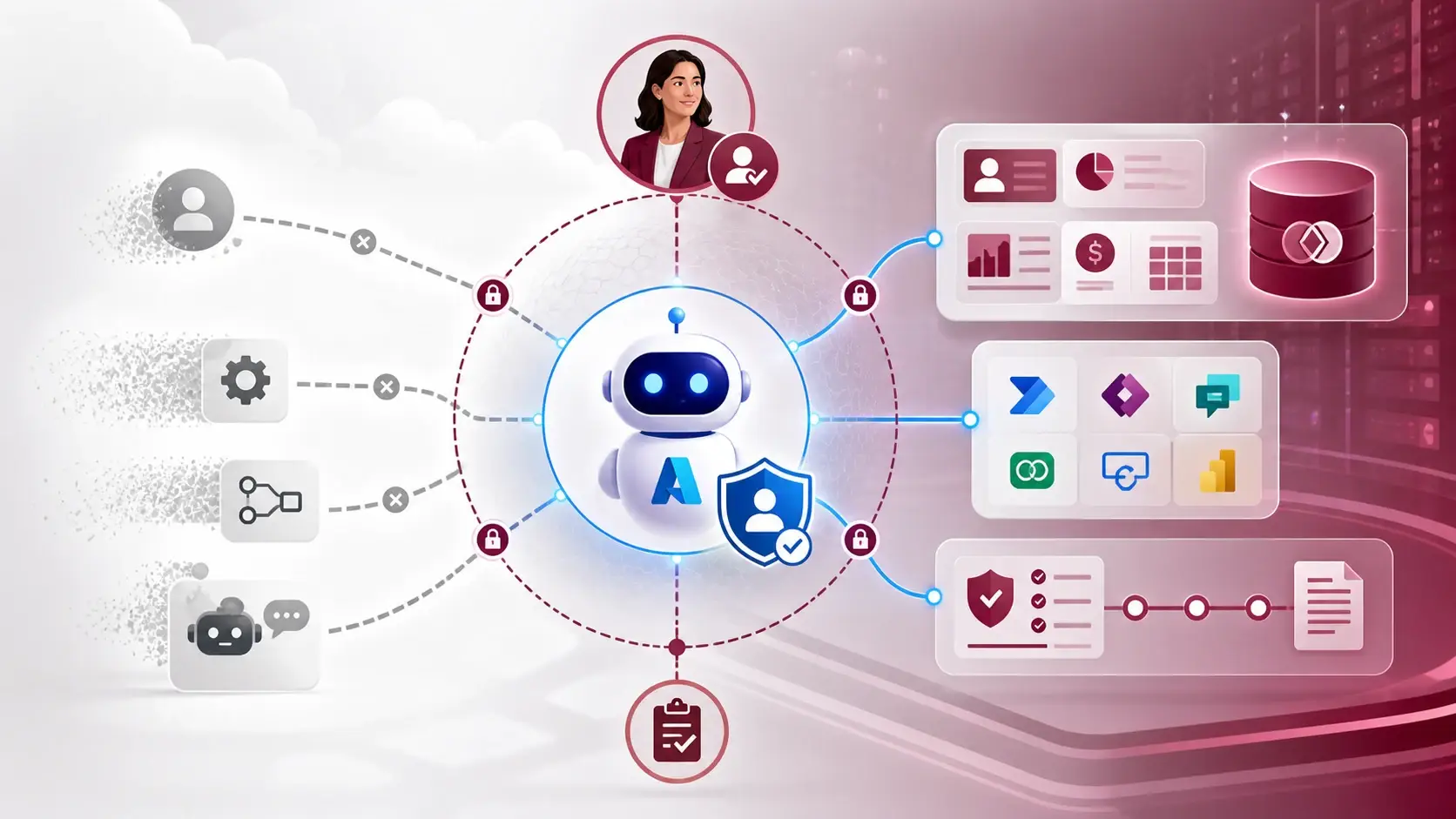
Dataverse is becoming the accountability layer for agentic business data
When a person changes a record, we can usually ask them why. When an agent does it, the record itself has to answer. That is the real shift: Dataverse becomes the place where the evidence for an agent's actions has to live.
Microsoft's 2026 release wave 1 positions Dataverse as a platform for agentic applications, with deeper use of business context, MCP, a Python SDK and closer links to Copilot experiences. It also lists Dataverse agent users with Microsoft Entra agent identity as planned for general availability in August 2026 — a reminder that some of this is direction, not yet something every tenant has. The identity side is covered in the Entra Agent ID article. This one is about the evidence.
Start with the investigator's question
Imagine a customer asks why their case was closed. Someone opens the record a month later. What do they need to see?
- who or what made the change — a person, or a specific agent;
- when it happened, and what the values were before and after;
- what the agent was asked to do, and what it used to decide;
- whether a person approved it, and who.
If the answer to any of these is "we would have to check the chat logs", the evidence design is not finished.
Where that evidence comes from
Most of it is ordinary Dataverse capability, used on purpose:
- A distinct actor. A shared integration account makes every change look the same. A dedicated agent user makes the actor visible.
- Auditing switched on where it matters — for the tables and columns an agent can change, with retention that matches how long you might need to investigate.
- Approval as data. When a person approves an action, record it on the record or a related one, not only in an email.
- Inputs worth keeping. Decide which requests, inputs and outputs are retained for review, and which are deliberately not kept for privacy reasons.
Test the bad days
A pilot should not only show that the agent works. Include missing data, conflicting ownership, a denied permission and a hand-off to a person. Then ask someone who was not involved to explain, from the records alone, what happened in each case.
I design an agent as a participant in a business process, not as a clever anonymous integration. If an investigator cannot rebuild the decision path from Dataverse afterwards, the automation is not ready for production.
A practical next step
Pick one table an agent will update. List the four investigator questions above and, next to each, where Dataverse will hold the answer. Any blank line is a gap to close before go-live.
Sources
References used for this article. Links open in a new tab.
- Microsoft Learn — Overview of Microsoft Dataverse 2026 release wave 1
- Microsoft Learn — New and planned features for Microsoft Dataverse, 2026 release wave 1
- Microsoft — Dataverse Is Your Agent Data Platform: Here’s What’s New
- Microsoft Learn — Security roles and privileges for Dataverse
- PuntoBello Blog — Building a Delivery Platform for the Microsoft Power Platform: Lessons from My Master's Thesis