Power Platform ALM is a delivery platform, not a deployment button
A deployment button answers one question: can this package move? A delivery platform answers all the others. With agentic tools now able to create a Power Pages site, configure Dataverse, add server-side logic and push the result through Power Platform Pipelines, those other questions matter more than ever.
The questions a button cannot answer
- Which version is being promoted, and what changed?
- Has it been validated, and by whom?
- Which environment is next, and who approved the move?
- How are environment-specific values and connection references handled?
- What happens if the result is not acceptable?
If your current process cannot answer these without asking a person, it is a button, not a platform.
Why AI raises the stakes
AI speeds up building. It also speeds up the arrival of unreviewed changes. A faster build without a stronger promotion process just moves risk downstream at greater speed.
Microsoft's direction is helpful here: the release plan points to GitHub integration, deployment from Git, better governance reporting and visibility of usage and connector dependencies. Dataverse Git integration lets solution objects and code-first assets live in source control together. Fabian Hutzli's delivery-platform case study shows the practical problem: once solutions are business-critical, moving them by hand between development, pre-production and production creates inconsistency, poor traceability and risk.
Agents are contributors, not the process
I treat agentic tools like a new team member. Their work goes through the same path:
- no secrets in prompts or repositories;
- generated changes reviewed;
- connection references and environment variables tested in the target;
- solution contents checked against what the team thinks is in there.
A successful import is not a successful release.
I stopped describing ALM as a deployment task. It is part of the operating model. The platform team should make the expected path clear enough for any maker to follow, and strong enough that production is never a shared experiment.
Where to begin
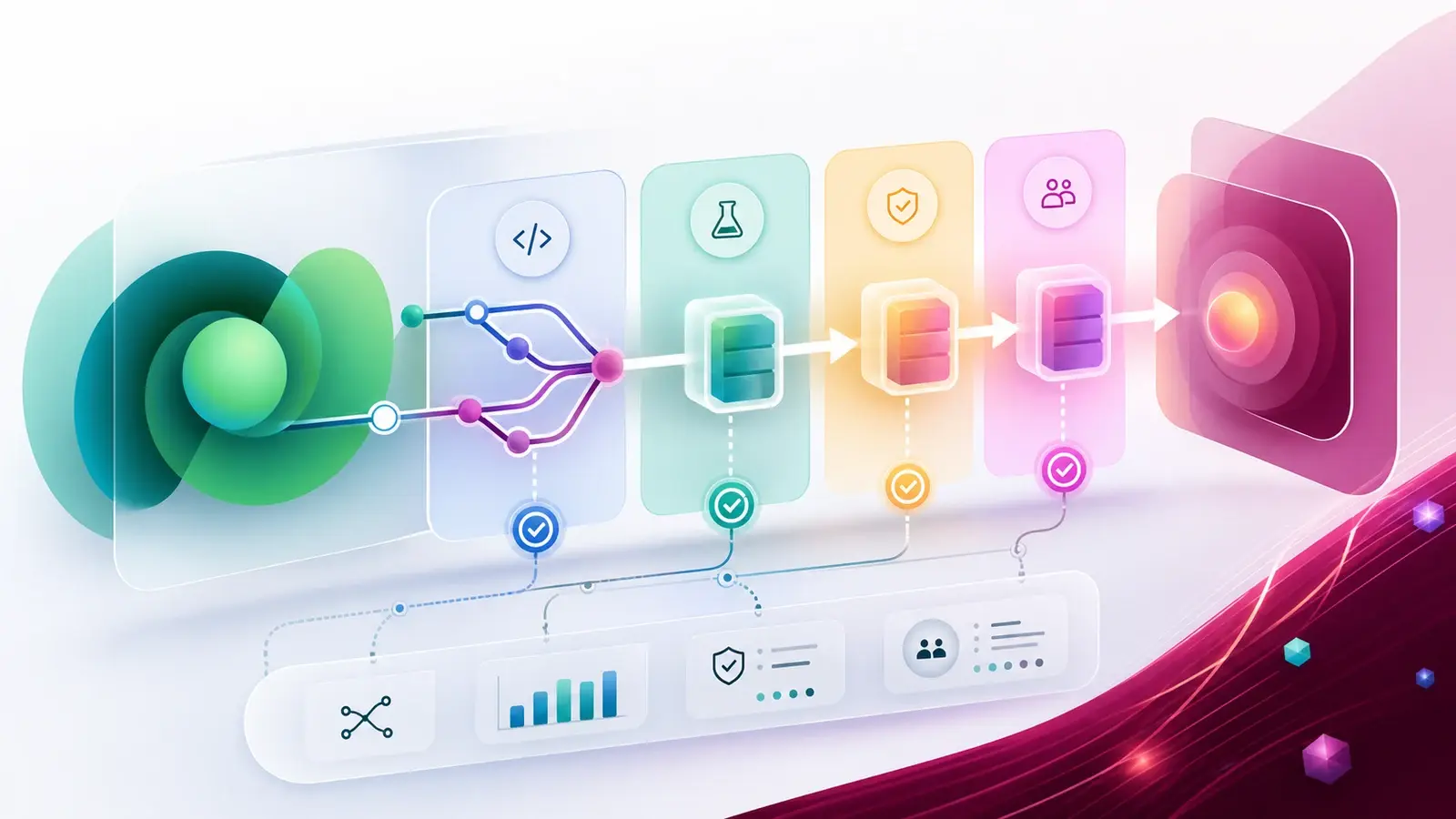
Not with a big pipeline catalogue. Start with development, validation and production, then add source control, solution boundaries, automated checks and a human approval.
Then map one real solution from development to production. Write down every manual step, every approval, every environment-specific value, and every point where the team has no evidence. Automate the most repeatable step first. That list makes a far better ALM backlog than a generic set of DevOps features. For a worked version of this path, see building a safe promotion path, and the ALM series covers each stage in depth.
Sources
References used for this article. Links open in a new tab.
- PuntoBello Blog — Building a Delivery Platform for the Microsoft Power Platform: Lessons from My Master's Thesis
- Microsoft — Build Power Pages Sites with AI through Agentic Coding tools, now Generally Available
- Microsoft Learn — Overview of Dataverse Git integration
- Microsoft Learn — Microsoft Power Platform 2026 release wave 1 plan overview